
Kava vs Alcohol
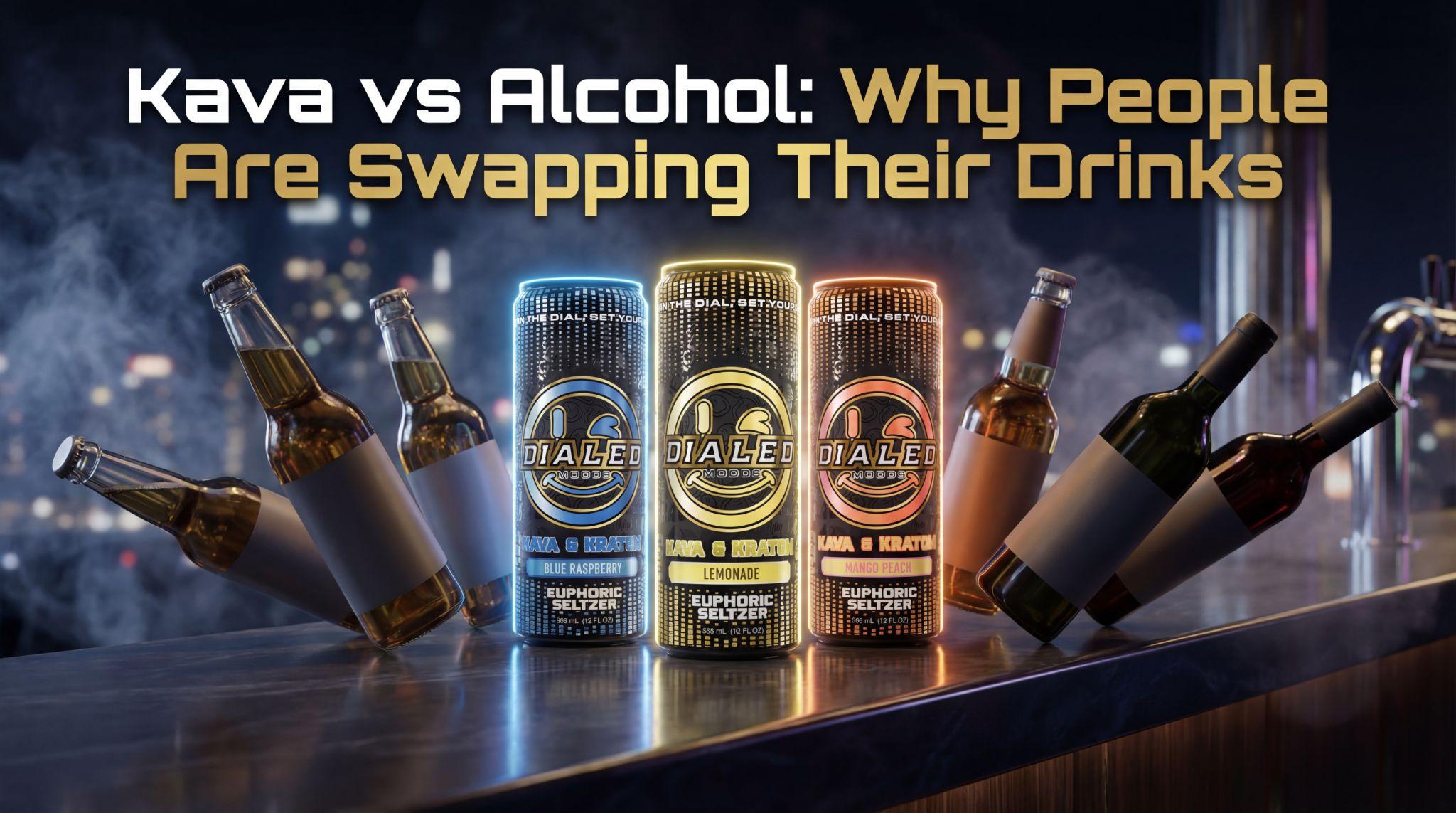
Kava vs Alcohol: Why People Are Swapping Their Drinks
How Alcohol and Kava Affect the Brain Differently
Alcohol is a non-selective central nervous system depressant. It potentiates GABA receptors, blocks NMDA glutamate receptors, and triggers dopamine release — all of which produce the initial relaxation and mood lift of a first drink. But it does this across the entire brain, broadly suppressing neural activity. Judgment, motor coordination, memory encoding, and emotional regulation all decline as blood alcohol rises. The curve bends sharply past one or two drinks.
Kava acts on GABA receptors through kavalactones, but more selectively. Kavain potentiates GABA-A at specific subunits without globally depressing neural activity. Motor coordination is preserved. Memory remains functional. The emotional regulation centers of the prefrontal cortex stay online. Kava no hangover vs alcohol is not just a marketing claim — it reflects a genuinely different pharmacological mechanism that leaves the brain's executive systems intact.
The practical result: you can relax and be socially at ease with kava at a level that, with alcohol, would already be impairing your judgment and altering your emotional behavior. The threshold between 'pleasantly relaxed' and 'impaired' is much narrower with alcohol than with kava.
The Social Effects of Kava Compared to Alcohol
Both kava and alcohol reduce social anxiety, which is why both have functioned as social lubricants across human cultures. But the quality of the social facilitation differs in important ways. Alcohol reduces inhibition broadly — lowering the psychological guard against saying things you'll regret, making decisions that feel right in the moment and wrong in retrospect, and experiencing emotional swings that make social dynamics unpredictable.
Kava social relaxation is narrower and more targeted. It quiets the anxiety response and reduces social self-consciousness without impairing empathy, judgment, or emotional memory. Conversations with kava are conversations you'll remember clearly. Decisions made while drinking kava are decisions you'd make sober — just made with less internal friction. This makes kava a meaningfully different social tool, not just a milder version of alcohol.

Kava Has No Hangover: What That Really Means
A hangover is the combination of dehydration, acetaldehyde toxicity, disrupted REM sleep, inflammatory cytokine release, and electrolyte depletion that follows alcohol metabolism. Kava does not produce any of these outcomes at moderate doses. Kavalactones are metabolized through a completely different pathway, do not produce toxic metabolites analogous to acetaldehyde, and do not disrupt sleep architecture in the way alcohol does.
What this means practically: the morning after a kava session at moderate doses is typically indistinguishable from any normal morning. Alertness, mood, and cognitive function are unaffected. There is no inflammation, no dehydration headache, and no emotional flatness. For people who have accepted hangovers as the inevitable cost of social drinking, this is genuinely novel.
Calorie and Sugar Differences Between Kava and Alcohol
Alcohol is calorie-dense: a standard beer contains 150 to 180 calories, a glass of wine 120 to 150, a cocktail 200 or more depending on mixers. Across a social evening, alcohol consumption can easily add 500 to 800 calories without any nutritional value. Regular consumption makes weight management significantly harder.
Quality kava seltzers and ready-to-drink kava beverages typically contain zero to minimal added sugar and 10 to 30 calories per can. The kavalactones themselves contribute negligible caloric load. For health-conscious people who want to participate in social drinking culture without the caloric overhead, the kava alcohol alternative is a concrete advantage, not just a qualitative preference.
Kava as a Tool in Alcohol Reduction
The pattern of using kava to reduce alcohol consumption is well-established in Pacific Island communities and is increasingly documented in Western harm reduction contexts. People who habitually drink one to two drinks per evening to decompress have found kava a direct replacement — same timing, same social function, different compound, better morning.
Kava's GABA-A activity means it partially occupies the same neurological territory as alcohol's relaxation effect, which is why the substitution often feels natural rather than like a deprivation. The drink ritual, the social signaling, the physiological relaxation — all of these translate to kava without requiring willpower-based abstention. [https://www.dialedmoods.com/\]
Situations Where Kava Works as a Direct Alcohol Substitute
Kava works best as an alcohol substitute in situations where the primary purpose of drinking is relaxation and social ease rather than taste pairing or cultural ceremony specific to a beverage type. After-work decompression, social gatherings, date nights, parties, watching live events — all of these contexts translate well to kava.
Situations where the alcohol substitution is less seamless: formal wine pairings with food where flavor is the point, or cultural contexts where specific beverage traditions are central to the experience. For the large majority of daily social drinking occasions, however, the function of alcohol is relaxation and social facilitation — and kava delivers both.
Frequently Asked Questions
Does kava produce a similar social relaxation effect as alcohol?
Yes, with an important distinction: kava's social relaxation is more targeted and doesn't impair judgment or memory the way alcohol does. The anxiety reduction and social ease are comparable; the cognitive and behavioral impairment is not.
Why does kava not cause a hangover the way alcohol does?
Because kava's metabolic pathway does not produce toxic byproducts like acetaldehyde, doesn't disrupt sleep architecture, and doesn't cause the systemic dehydration and inflammation that drive alcohol hangovers. Moderate kava consumption leaves the body and brain in the same state the next morning.
Can kava help people who are trying to drink less alcohol?
Yes. Kava occupies the same GABA receptor territory as alcohol's relaxation mechanism and serves the same social function, making it a natural substitution rather than an abstinence exercise. Many people successfully reduce alcohol consumption by replacing evening drinks with kava.
Is kava safe for people in sobriety or alcohol recovery?
This is a nuanced question that depends on the individual's recovery context and the advice of their treatment team. Some harm reduction frameworks support kava for people in alcohol recovery; traditional abstinence-based programs may not. This decision belongs to the individual and their healthcare provider.
How does the caloric content of kava drinks compare to beer or wine?
Significantly lower. A beer or glass of wine contains 120 to 180 calories. A quality kava seltzer typically contains 0 to 30 calories per can. Across an evening, the calorie difference between alcohol and kava consumption is substantial.
Switch the drink, keep the ritual. Dialed Moods kava seltzers deliver the social ease without the morning-after price.